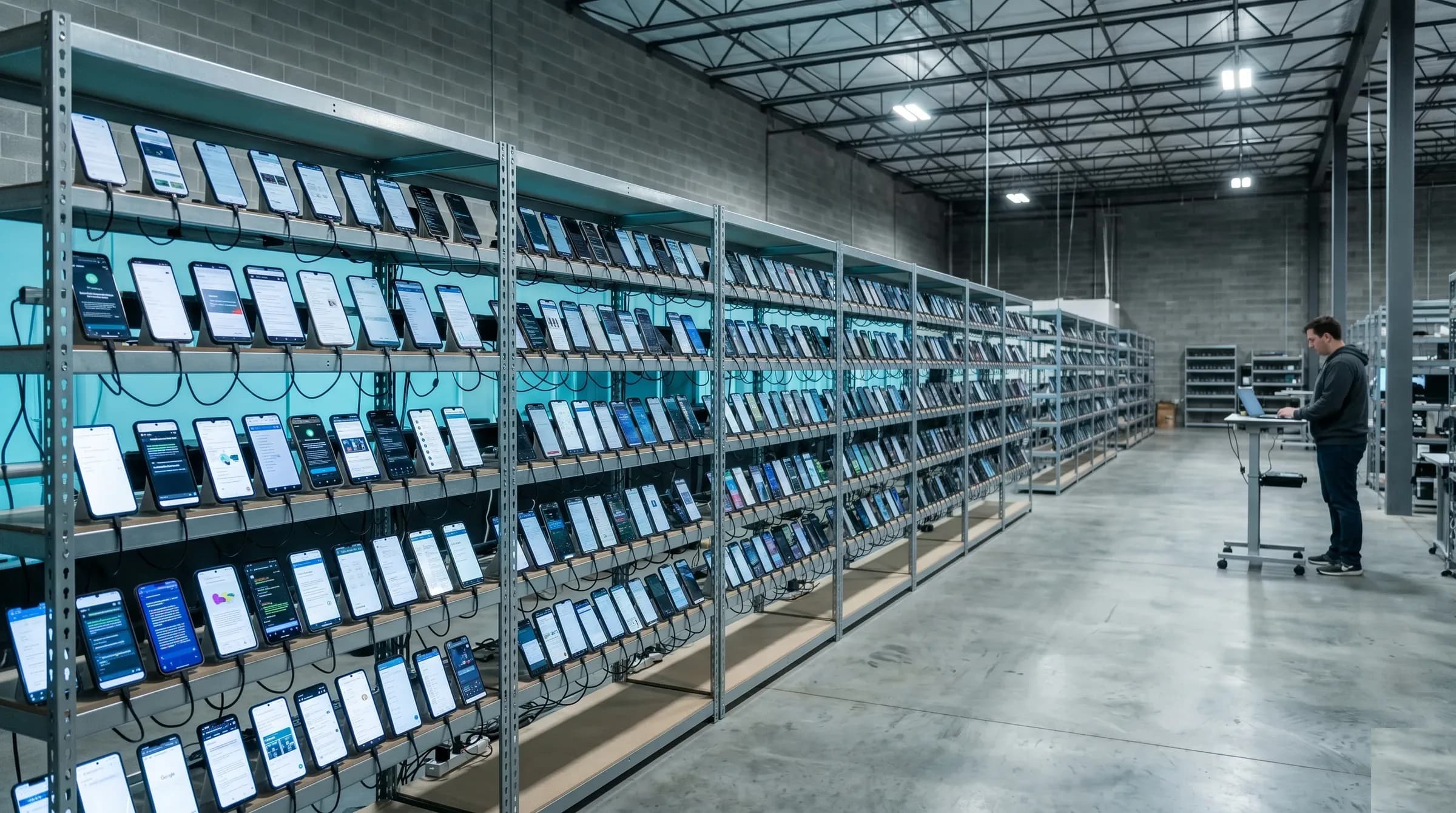
Here is how Top3 works, with nothing behind the curtain. The ranking work is classic and white-hat: our ops team makes your business the easiest one for AI engines to read and trust — entity alignment, local listings, content, consistency — and keeps it that way. The farm is the other half: 10,000+ real consumer phones and laptops across US metros that ask the engines exactly what your buyers ask and photograph the answer, daily. Your brand becomes the answer — and you pay nothing until a screenshot proves it.
Other tools sample AI from a datacenter — a context no real customer is ever in. Top3 measures from real devices in real places, which is why our evidence is screenshots instead of estimates. This page is the technical explanation of why that difference matters.
Consider a real receipt from our measured library: Heavy Duty Diesel Specialists in Albany. On May 7, 2026, a real phone asked ChatGPT for the best roadside assistance and recorded them at #8. Fourteen days later the same question on the same device returned them at #1 — both captures published, rank lines visible, at top3.cloud/results. No inference, no dashboard score: a photographed before and a photographed after.
New to the category? What Is Answer Engine Optimization? gives the foundation this post builds on.
What the Device Farm Actually Does
One thing, relentlessly: it measures. Engine answers vary by location, session, and model version — so the only way to know what ChatGPT tells a buyer in your city is to ask it from a real device in your city and record the answer. The farm does that for every measured keyword, every day, across ChatGPT, Gemini, and Perplexity — and checks your Google Maps position the same way.
To be equally explicit about what it does NOT do: it never clicks your listing to inflate engagement, never simulates demand, never injects anything into any ranking system. That method class — click farms, "GPS drives," bot traffic — is what Google's anti-manipulation enforcement removes, and it is the opposite of how Top3 works. Three things make the measurement trustworthy:
1. Real consumer hardware, not datacenter servers. Every device is an actual consumer phone or laptop running the real consumer product — the same app your buyer uses, not an API endpoint. What it records is what a customer would see.
2. Real US locations. ChatGPT Search, Perplexity, and Gemini all incorporate geographic context. A measurement from a device in Phoenix captures what a Phoenix buyer is actually told — which is why we measure in the exact metros our customers care about instead of extrapolating from a datacenter.
3. Repetition and dating. A single answer is an anecdote. We measure daily, stamp every capture with rank and date, and require a win to reproduce across multiple measurements before it can ever trigger billing. Ranks are reported as dated observations, never as permanent positions.
Dashboards estimate. Top3 photographs. A real-device farm is the only instrument that sees exactly what your buyer sees.
The Work Ranks You; The Farm Proves It
Ranking work is only worth paying for if you can prove it worked. That is the division of labor.
The work. Our ops team executes the white-hat deliverables AI engines read for your named keyword — entity alignment across the surfaces engines pull from, consistent local listings, real content in your buyer's language, schema, and index hygiene — and keeps it all current as models update. This is the ranking engine, and it is why Top3 is a hands-off service.
The proof. The device farm measures what ChatGPT, Gemini, and Perplexity actually show real customers — before we start, while the work compounds, and after — with a dated, rank-stamped screenshot for every reading. The farm has no ability to influence what it measures: a measurement is a search and a screenshot.
Why not just measure through the API, like everyone else? Because the API is not the product your buyer uses. Consumer apps carry location, session, and product context that anonymous datacenter calls do not — and in our measurements the two frequently return different business names for the same local question.
The divergence is worst exactly where it matters most: local, category-specific questions — "best plumber near me" asked in your city. A datacenter can sample the model; it cannot stand where your customer stands. That is why we treat real-device captures as the only evidence worth billing against.
The receipts page shows what this looks like in practice: 92 businesses measured on our engine, 401 documented climbs into the top 3 of AI answers, 175 of them ending at #1 — each one a same-device, same-question before-and-after with the engine's own rank line visible in the capture. The median measured climb ran 14 days (range 14–48). Those are measurements, not promises — and every one is published at top3.cloud/results.
The work ranks. The farm photographs. Together they make the guarantee enforceable.
What a Real-Device Farm Sees That No API Can
The farm observes the consumer product the way a buyer experiences it. API-based systems cannot see any of the following, which is why their numbers drift from reality.
Real geographic presence. Each device is physically in its target metro. Geographic context at the consumer product level is derived from the device's actual network — not from a location parameter — which is why we can measure your visibility in Phoenix, Denver, or Dallas specifically.
The real consumer surface. Engines personalize and render differently for the consumer product than for the API. Measuring through the product your buyer actually uses is the only way to record the answer your buyer actually gets.
The full consumer product stack. The consumer-facing ChatGPT, Perplexity, and Gemini surfaces — including safety pipelines, browsing behavior, and recommendation rendering — are separate from the API pipelines. Our fleet measures the real product. API tools cannot see what the real product does.
Session-to-session variance. Real engine answers move between sessions and model updates. Single-shot sampling mistakes that variance for fact. We measure repeatedly and report dated, sampled observations — which is also why a win must reproduce across measurements before billing can start.
The result is a measurement standard no dashboard matches: what your buyer sees, recorded from where your buyer stands, with a screenshot you can check yourself.
Inside the Infrastructure

The farm is 10,000+ real consumer phones and laptops distributed across US metros — real devices on real connections in the markets they measure, never a datacenter IP. Every unit measures the consumer surfaces of ChatGPT, Gemini, and Perplexity, plus Google Maps position — recording each answer the way an actual customer would see it.
The fleet is organized by metro and by keyword. When you name a keyword — say, "personal injury attorney in Phoenix" — Phoenix-based devices run the natural-language buyer versions of that keyword on each engine, daily, and record whether your business is named and at what position. Meanwhile the ops team starts the ranking work: entity alignment, local listings, content, consistency — the deliverables the engines actually read.
Every new keyword gets a baseline before any work begins, then daily measurement while the work compounds. You receive before-and-after evidence showing exactly which engines now recommend you, in which metros, for which prompts — captures, not inference; screenshots, not extrapolation.
None of this requires anything from you. You name the keyword; we do the work and run the measurements. You do not give us website access, you do not rewrite content, you do not edit schema — our ops team handles the deliverables, and the farm documents the outcome.
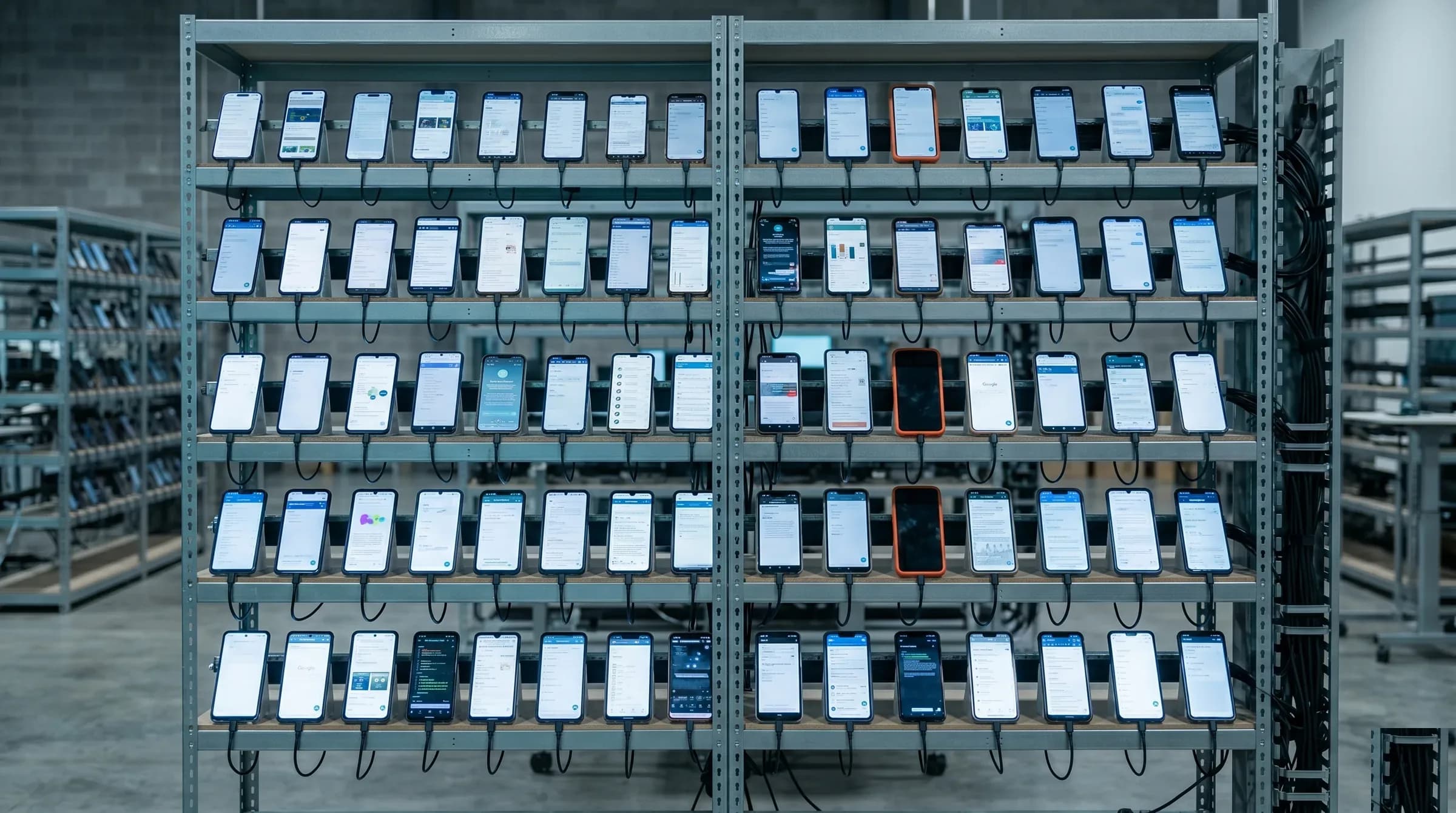
We do not give you an inferred score. We give you dated, rank-stamped captures from real devices in the metros you named.
"You name the keyword. We do the work — and prove it." — The core proposition in one sentence. See how the service works
What We Learned Building the Moat
Building and operating the measurement fleet produced five load-bearing lessons. Each of them is baked into how we publish evidence today.
Location dominates the answer. Engine answers are metro-local. A measurement taken in the wrong city describes a buyer who does not exist. The farm spans real US metros by design, and we measure in the metros a customer actually serves — which is why our captures describe their buyers, not a national average.
Session context changes answers. The same question can return different names across sessions and product states. That is a measurement-design problem: we sample repeatedly, date every capture, and never present a single observation as a stable position.
API proxies drift from reality. Comparing API-based observations with real-device observations on local queries showed frequent, material disagreement — the API often described an answer no buyer in the metro was seeing. That is why we treat datacenter sampling as directional at best and never bill against it.
Answers move faster than the industry assumes. Conventional wisdom says AI visibility moves in quarters. Our measured library says otherwise: the median documented climb into the top 3 ran 14 days (range 14–48) across 401 climbs — a measurement, not a promise, and part of why free-until-you-rank is a workable guarantee rather than marketing copy.
Separation of work and proof is non-negotiable. The people doing the ranking work must not be the ones grading it. The farm measures independently of the ops team, every capture carries its rank line in the pixels, and the unflattering readings get recorded too. That separation is what makes a Top3 before-and-after worth more than a vendor report.
Why This Is a Category of One
Every other operator in the AEO category sells one half. Dashboard vendors measure — usually from a datacenter — and leave the work to you. Agencies do work — and prove it with PDF reports you cannot check. Top3 pairs done-for-you white-hat work with a real-device measurement farm, at a scale that cannot be reproduced with an API key and a few servers.
That pairing is the moat. It is why the guarantee can be structural instead of rhetorical: billing waits for a photographed win, and the photograph comes from an instrument the ops team cannot influence. Competitors can show you a dashboard. We ship you recommendations — with the receipts.
We publish the methodology openly because the bar for what counts as "AI visibility" work should be higher than it is. A vendor that cannot show you a verifiable capture of the outcome is selling a report, not a result. That is a fine product, but it is not the same product.
If you are evaluating any AEO vendor, ask two questions: "Do you do the work, or just report on it?" and "Can I see verifiable proof of an outcome?" Those two answers will sort the category for you.
The customer experience of hiring Top3 is: you name a keyword, and your brand becomes the AI's answer for that keyword. Everything that produces that outcome — the ops team running entity, schema, local listings, and content; the measurement fleet photographing the answers — runs without you lifting a finger. That is what hands-off actually means.
The same farm also measures the Map Pack. Real devices in real US metros see the same 3-pack your customers see — so the same fleet that proves your AI answers also tracks your Google Maps position daily. One campaign, two surfaces, one standard of proof: the profile, listing, and content work feeds both. See how the Map Pack works.
Conclusion
Building a real-device farm was the slower, harder path. The datacenter approach would have shipped six months earlier — and would only ever have estimated. What we built photographs the truth. That is the difference between a reporting tool and a guarantee you can enforce.
The receipts page is the product demo: named businesses, before-and-after captures from the same real phone, the engine's verdict quoted verbatim — including the parts that aren't flattering. 401 documented climbs across 92 measured businesses, each one checkable at top3.cloud/results. That is the product.
You name the keyword. We do the work, and real phones photograph the result. Your brand becomes the answer, measurably — and you pay nothing until it does. Hands-off, with receipts.